
An exchange takes goods back and gives out replacement goods, worked on one screen as two documents: a return and a sale. You find the original sale, select the lines coming back, then add the replacement goods on the exchange basket. What happens next depends on which way the money goes.
Prerequisites
- A settled sale to return the outgoing lines against.
- The ordinary return permission on your sign-in.
- A store-credit payment method set up. Without one, an exchange finishes at a register.
Working an exchange
- Find the original sale and select the lines coming back, exactly as for a return. See Returning With a Receipt.
- Switch to the exchange basket and add the replacement goods, the same way you build any basket. See Selling. There is no restriction on what the replacement may be: no same-item rule and no same-category rule. Commercially an exchange is a return plus a resale, and the product treats it that way.
- The screen shows the direction your store's system computed: the customer owes more, the store owes money back, or it is even. The phone shows that direction and never re-adds it.
That direction decides what happens next, and the three answers are genuinely different. Read the screen's own wording before you hand anything over.
An even swap or a net charge
Where the replacement costs the same (an even swap) or more (a net charge):
- The credit note submits on its own and mints a store-credit certificate.
- The replacement basket sells as an ordinary sale, redeeming that certificate.
- Where the replacement costs more, the difference is taken here through the ordinary payment path, using any method your store takes.
If the replacement payment fails after the credit note has posted, the state you are left in is clear and recoverable: the customer's goods are returned and their store credit is kept. It can be redeemed at any later payment, and it is never lost.
A net refund
Where the replacement costs less than the goods coming back, the exchange is a net refund, and it behaves differently from the two cases above.
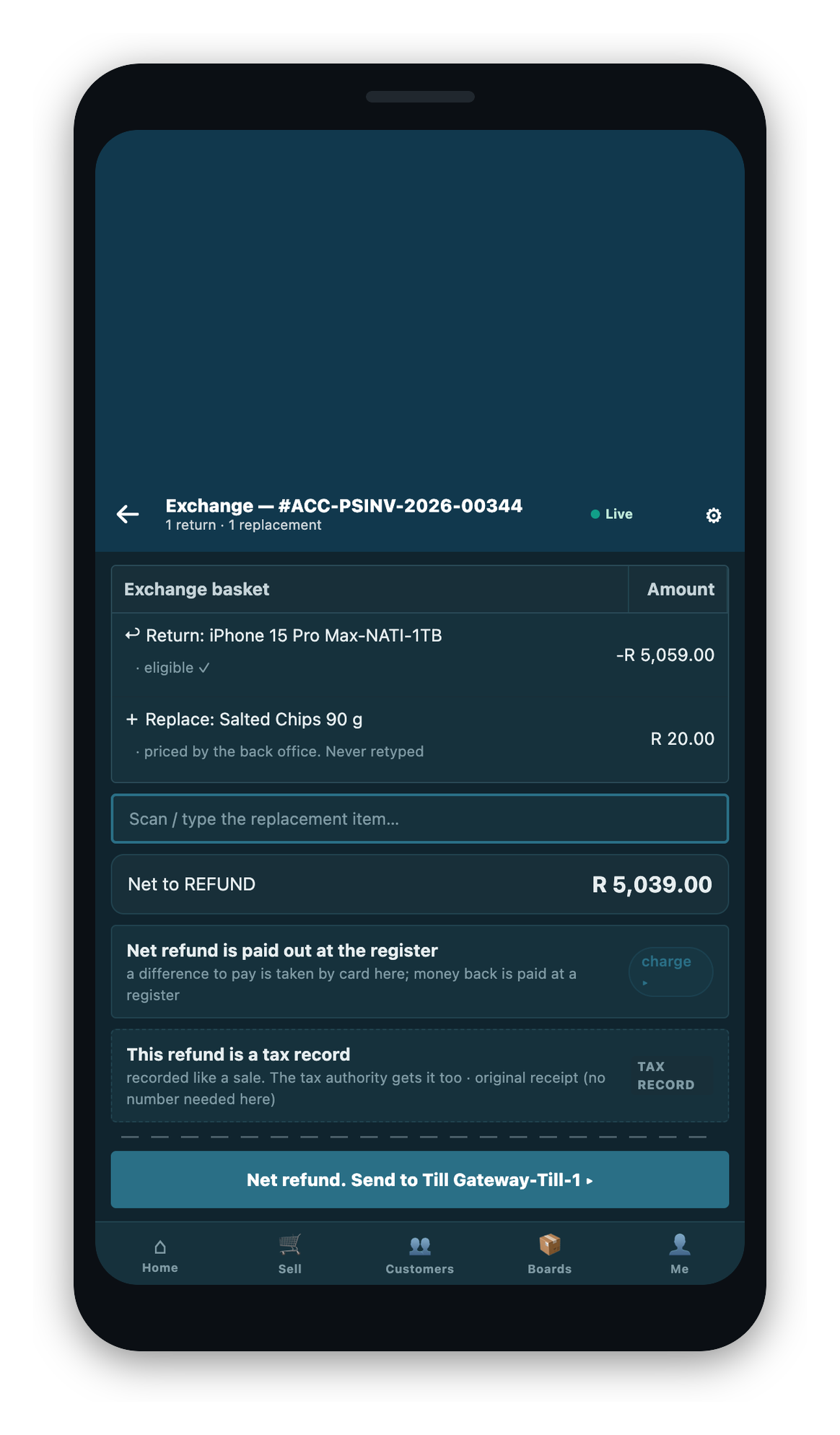
On this route the phone posts nothing. No credit note is submitted here, and no store-credit certificate is minted here. Both documents, the credit note and the replacement basket, are kept at a register you choose, and that register completes them together.
Because nothing is settled on the phone, the customer's money and their replacement goods are both still pending at that point. The replacement goes with the customer to the register, not over the counter here. Everything the cashier needs to get this right is on the screen: which way the money goes, that the phone will not settle it, and which register it is going to.
Other things to know
- An exchange survives a reload. The phone keeps a per-sale record of where you were, so if the screen is reloaded part-way through, you resume rather than starting again or minting a second credit note.
- An exchange payout is not split. Where an exchange does pay out to store credit, it is one certificate per exchange, which the replacement sale immediately redeems. You cannot split an exchange payout across several destinations. On the net-refund route there is no certificate to split, because the register settles it.
- No store-credit method, no on-phone exchange. If your store has no store-credit payment method set up, an exchange finishes at a register instead.
Related Topics
- Returning With a Receipt: selecting the returning lines
- Selling: building the replacement basket
- Returns and Exchanges: the overview